


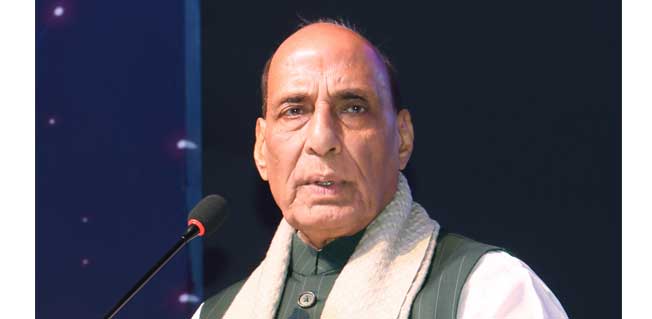
“Our manufacturing vision must be guided by the principle of ‘Make in India, Make for India, and Make for the World’”
Greater Noida : Raksha Mantri Shri Rajnath Singh has called upon Micro, Small and Medium Enterprises (MSMEs) to invest a portion of their turnover in research, development and technology upgradation, while fostering partnerships with universities, IITs, research institutions, DRDO laboratories, start-ups and large industries. Addressing an MSME event in Greater Noida, Uttar Pradesh, on September 1, 2026, he urged MSMEs to evolve from domestic suppliers into global enterprises and contribute to the achievement of the Viksit Bharat @2047 vision. He stated that Viksit Bharat represents a nation that is globally competitive in manufacturing, a leader in technology and innovation, and self-reliant in its strategic and economic capabilities, while generating ample employment opportunities for the youth.
Emphasising the need to strengthen the global competitiveness of Indian MSMEs, Shri Rajnath Singh said the ongoing transformation of global supply chains and increasing demand for reliable manufacturing partners present a significant opportunity for India. He highlighted the steps being taken under the leadership of Prime Minister Shri Narendra Modi to deepen India’s trade partnerships with key nations, including through Free Trade Agreements with the US, UK, New Zealand, Oman, Switzerland and the European Union. He said these FTA networks offer vast opportunities for global trade and exports and urged MSMEs and industries to leverage these partnerships and government initiatives such as Credit Guarantee Expansion and GST rationalisation to take Indian products to markets across the world. “Our manufacturing vision must be guided by the principle of ‘Make in India, Make for India, and Make for the World’,” he said.
The Raksha Mantri also highlighted the Government’s efforts to integrate MSMEs into the formal economy and create an enabling ecosystem for their growth. He noted that the number of MSMEs has increased from around 4.67 crore in 2012-13 to approximately 8 crore today, reflecting the growing depth and dynamism of India’s entrepreneurial ecosystem.
Highlighting the immense potential of MSMEs in defence manufacturing, Shri Rajnath Singh said initiatives such as iDEX and ADITI are enabling start-ups, innovators and MSMEs to develop cutting-edge solutions for the Defence Forces. He urged entrepreneurs to view the defence sector as a gateway to technology, innovation and global business opportunities. He identified drones, Artificial Intelligence, robotics, cybersecurity, advanced electronics, sensors, autonomous systems, advanced materials, space technology and quantum technologies as areas offering significant opportunities for Indian MSMEs.
Shri Rajnath Singh underlined that technology alone cannot drive the growth and global competitiveness of MSMEs, stressing that equal attention must be given to quality, skill development, technology upgradation, market access and finance. He stated that Indian MSMEs must establish their identity in global markets through quality and reliability, particularly in the defence sector, where the reliability of every component directly influences the operational effectiveness of the Defence Forces. He emphasised that the defence manufacturing ecosystem must remain committed to the principles of “Zero Defect” and “Zero Compromise on Quality”. He also highlighted the importance of equipping young people with industry-relevant skills and encouraging MSMEs to continuously upskill their workforce to meet the requirements of modern industry.
The Raksha Mantri further called for advanced technologies such as digital manufacturing, automation, Artificial Intelligence and modern production methods to be made more accessible and affordable to MSMEs. He identified market access as a key enabler of scale and urged greater participation of MSMEs in government procurement, the vendor ecosystems of large industries and export markets. Emphasising finance as one of the most critical requirements for MSME growth, he said timely and affordable access to capital must go hand in hand with financial discipline and sound business practices. According to him, these five pillars—technology, quality and skills, technology upgradation, market access and finance—will be essential for enabling Indian MSMEs to become globally competitive and contribute meaningfully to the vision of Viksit Bharat @2047.
Shri Rajnath Singh highlighted the special significance of North India’s MSME sector in the country’s industrial development, noting its strong presence across manufacturing, engineering, automobiles, electronics, defence, textiles, food processing and services. He said the Defence Industrial Corridor, particularly in Uttar Pradesh, has created new opportunities for defence manufacturing, with the state emerging not only as a major market but also as an important hub of India’s new manufacturing and defence ecosystem. He urged MSMEs in Uttar Pradesh, Uttarakhand, Delhi and Haryana to fully leverage these opportunities and evolve from suppliers to large defence companies into technology developers, system suppliers and exporters.
Raksha Mantri called for inspiring India’s youth to become job creators rather than job seekers, underlining entrepreneurship as an important instrument of nation-building. He stressed the need to create greater opportunities for women and youth and to develop small cities and towns as new centres of economic growth. He stated that the vision of Viksit Bharat by 2047 is not merely a government objective but a collective aspiration requiring the joint efforts of the government, industry, MSMEs, start-ups, academia and civil society. “The progress of an MSME is the progress of India,” he said.
