


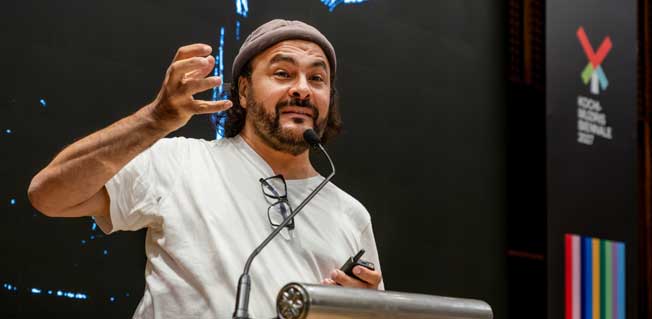
Kochi: Kader Attia, curator of the seventh edition of the Kochi-Muziris Biennale (KMB), has begun a research visit to Kochi, engaging in site visits and conversations ahead of the next edition of the international contemporary art exhibition. Attia will unveil his curatorial proposition in Mumbai on November 14, offering the first public glimpse into the vision that will shape the upcoming Biennale. The announcement was made by the Kochi Biennale Foundation (KBF), organisers of KMB, during a media interaction with Attia in Kochi.
The interaction was attended by Dr Venu V., Chairperson of the Kochi Biennale Foundation; Jitish Kallat, President of the Kochi-Muziris Biennale; Adeeb Ahamed, Trustee, KBF; and Thomas Varghese, CEO, KBF. Attia’s current research journey began in Mumbai, where he met cultural practitioners and others, before continuing to Kochi with site visits and conversations. An internationally renowned Algerian-French artist and curator, Attia has a longstanding association with Kochi. He delivered the inaugural Vivan Sundaram Memorial Lecture in 2025 and had previously participated in two exhibitions in Kochi curated by Jitish Kallat — Whorled Explorations, presented as part of the 2014 Kochi-Muziris Biennale, and Tangled Hierarchy in 2022.
During the media interaction, Attia spoke about his artistic practice, his return to Kochi in his new role as curator, and the conversations and encounters that are beginning to inform his research for the upcoming Biennale. Dr Venu V. said Attia’s selection reflects the identity of the Kochi-Muziris Biennale, noting that his engagement with contemporary art and his interest in history, memory and culture resonate closely with the character of the Biennale. Introducing Attia, Jitish Kallat spoke about the longer process through which a Biennale takes shape and acknowledged the longstanding role of Kerala’s press in bringing artists and their ideas into public conversation.
Adeeb Ahamed described the Biennale as a collective endeavour and called upon people in Kochi and across Kerala to participate in and take ownership of its next chapter by welcoming artists, perspectives and ideas from around the world. Attia also shared images of his work and discussed aspects of a practice that, for more than two decades, has explored questions of memory, history, repair and the continuing legacies of colonialism.
A central element of Attia’s artistic inquiry is the idea of “traces” — the marks left by history, trauma and experience. He noted that the human psyche carries traces associated not only with trauma but also with joy, opening up political, philosophical, metaphysical and poetic questions. He described the question of traces as central to his interest in understanding the legacy of colonialism in the 21st century. Reflecting on observation, repair, memories of his mother and the invisible traces left by those who are gone, Attia explored ideas of wounds and repair while also reflecting on Kochi’s engaged local audience and the sense of reciprocity he has encountered in the city.
